
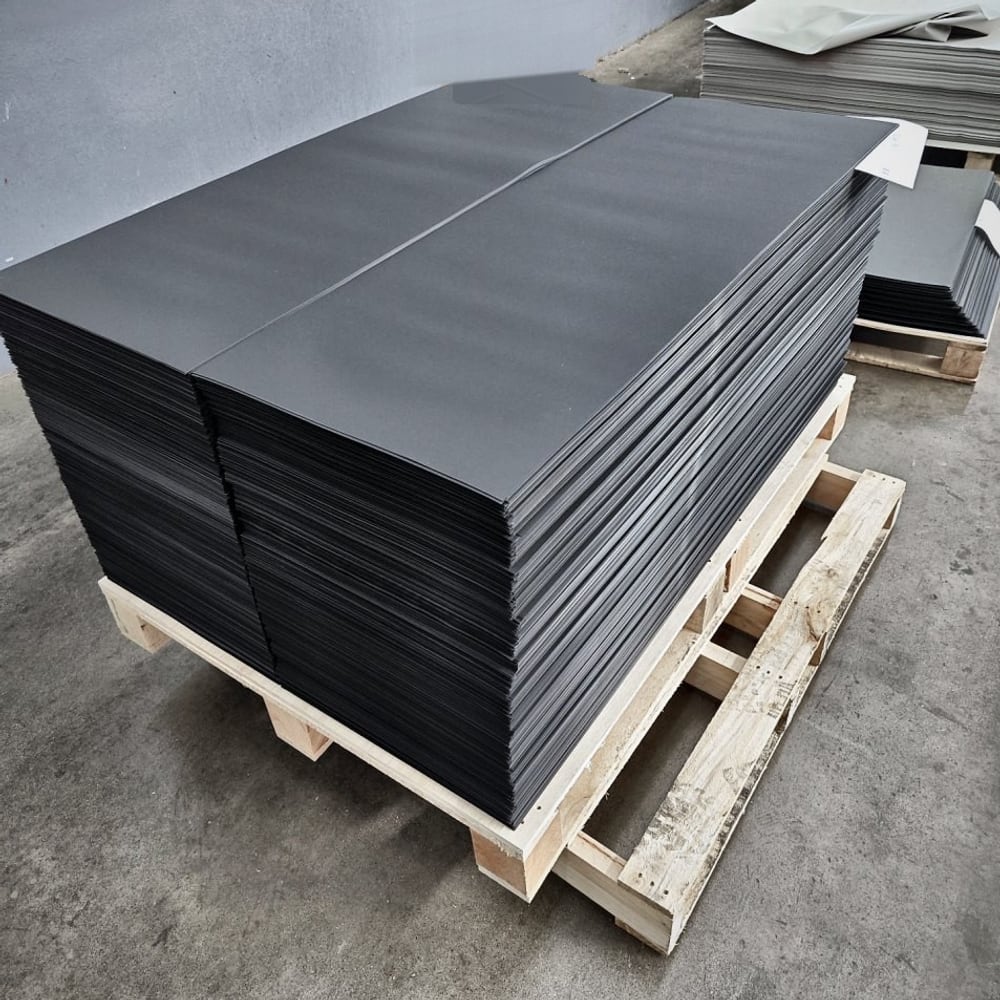
Product
Cooling Tower Sheet
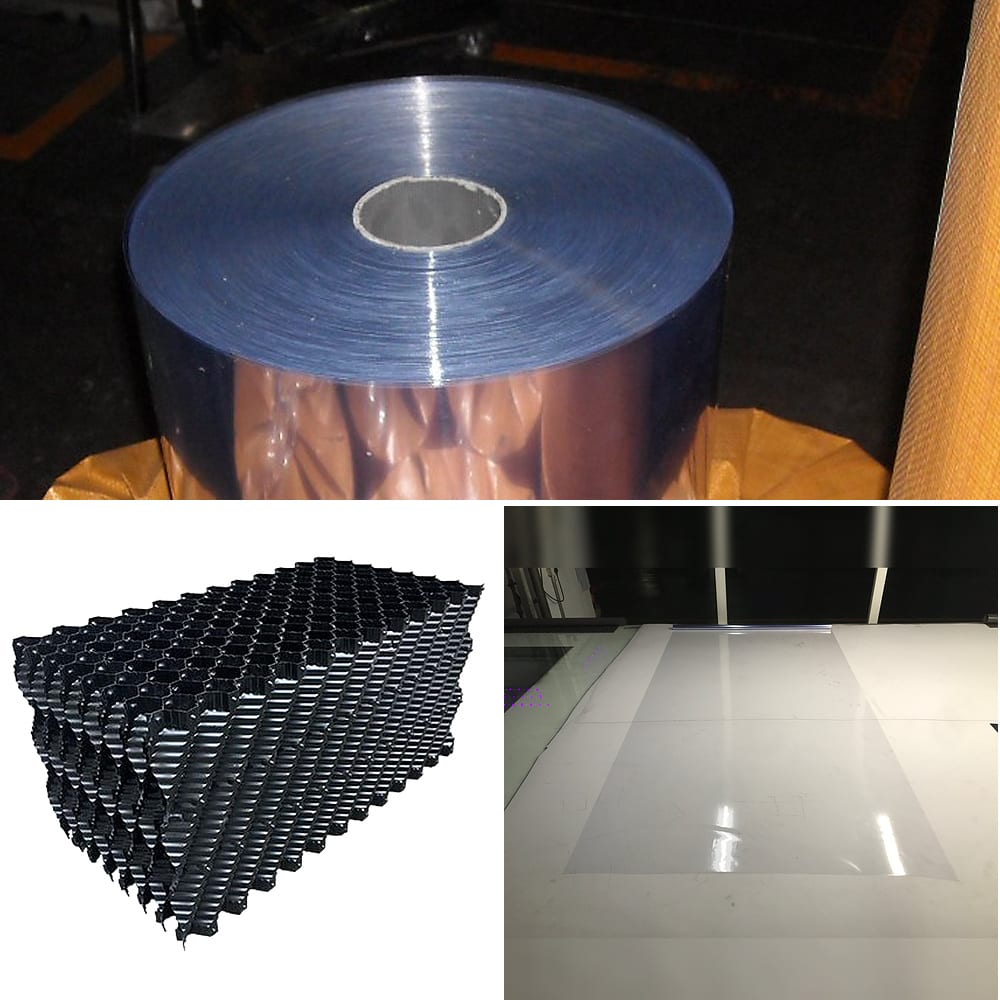
Rigid PVC sheet for cooling tower fill, 0.38–0.50 mm thick and 500–1300 mm wide, supplied in 150–400 kg rolls or cut sheets. It is formed into corrugated or embossed film fill for counterflow, crossflow and HVAC towers, and is tested to CTI-136 and ASTM E84, REACH and RoHS compliant.
Specification
Values below are for the standard grade. Confirm thickness, width and forming against your own process before ordering; a datasheet is issued for the exact gauge quoted.
| Material | 100% virgin PVC compound, no filler and no regrind |
| Type | Rigid, vacuum forming grade |
| Colour | Black, grey, blue or clear; matched to your sample |
| Thickness | 0.38 – 0.50 mm |
| Width per roll | 500 – 1300 mm |
| Weight per roll | 150 – 400 kg |
| Surface | Smooth, or embossed to the fill pattern you name |
| Standards | CTI-136, ASTM E84, REACH, RoHS |
| Packaging | Rolls wrapped in plastic film, standing on pallets |
| Production capacity | 500,000 kg per month |
| Delivery | 2 weeks and up after deposit |
| Payment | TT, L/C, Western Union, MoneyGram |
| MOQ / trial order | 1,000 kg / 300 kg |
What the sheet has to do inside a tower
Fill is where the heat actually leaves the water. The sheet is formed into corrugated or cross-fluted packs so that water runs down one face as a film while air passes through the gaps. The more wetted surface the pack exposes, and the better it breaks the water up, the smaller the tower can be for the same duty.
That puts the requirement on the sheet rather than on the finished pack. It has to take the forming temperature without thinning unevenly, hold the formed profile without sagging when it is wet and warm, and stay flat enough that packs stack to the design spacing. A sheet that forms beautifully but creeps after a season costs more than it saved.
Why the range stops at 0.38–0.50 mm
Below about 0.38 mm the crest of the corrugation thins during forming and the pack loses stiffness. Above 0.50 mm the sheet still forms, but the pack gets heavier and costs more per cubic metre of fill. Most counterflow and crossflow patterns we supply sit around 0.40 mm.
Colour is not a performance grade
Black, grey, blue and clear are the same compound with different pigment. Colour is chosen for how the fill looks in service, or for the buyer’s own specification — it does not by itself make the sheet UV stable or fire rated.
Forming, and what to send with an enquiry
We supply sheet, not assembled fill. Buyers heat it, emboss the pattern, form and cut it, then bond the sheets into blocks. Because the pattern is your tooling, the useful information on an enquiry is the fill you already make, the finished pack dimensions, and the water and air loading the tower runs at — not just a thickness.
- Pattern: a sample of your current fill, or a drawing with pitch and flute angle
- Thickness and width: 0.38–0.50 mm, 500–1300 mm
- Colour: black is the usual choice for cooling towers; grey, blue and clear on request
- Packing: 150–400 kg rolls standing on pallets, or cut sheets
Temperature, water chemistry and fire performance
Standard grade covers the usual HVAC and industrial cooling duty. Where the water runs hotter, or the site uses an aggressive treatment programme, the compound changes. Tell us the operating temperature and the chemicals dosed, and we confirm the grade rather than let you find out in service.
For projects that ask for documentation, the sheet is tested to CTI-136 for fill performance and ASTM E84 for surface burning, and is supplied REACH and RoHS compliant. The reports go out with the shipment and refer to the exact lot.
Where it goes
Four places this grade is bought for, and what changes in each.
Industrial process cooling
Fill for towers serving chemical, plastics and metal processing plants, where water quality and temperature differ site by site.
HVAC cooling towers
Commercial buildings, hospitals and shopping centres. The fill is chosen for the tower duty, not for the type of building.
Power and energy
Larger towers with heavy thermal load, where the fill pattern and the stiffness of the sheet matter more than the price per kilo.
Replacement fill projects
Contractors matching new sheet to an existing tower: send a sample of the old fill together with the pack dimensions.
Cooling tower sheet — technical questions
Do you supply finished fill packs, or only the sheet?
Only the sheet. Forming, embossing and assembly are done by fill manufacturers and maintenance contractors, and those are the people we supply. If you need finished packs we can tell you what the sheet has to meet, but we do not assemble them.
Can you match the pattern of our existing fill?
Send a sample, or a drawing with the pitch and flute angle. If the embossing roll is one we already hold, matching is straightforward. If it has to be made, that is a separate item with its own lead time, so it is worth settling before the price is fixed.
What is the maximum service temperature?
It depends on the load and on the water chemistry, so we do not publish one number. Standard grade covers normal HVAC and industrial duty; for hotter water we supply a medium-temperature compound. Give us the operating temperature and we will confirm in writing.
What is the minimum order?
1,000 kg per specification, with a 300 kg trial order for a first run. Standard packing is 150–400 kg per roll; other roll weights are available if your line takes them.
The other product
Most buyers order the same grade repeatedly; if you need both, they can share a container.
Ask for the Cooling Tower Sheet datasheet
Tell us the thickness, width, color and monthly quantity you need. We reply with the datasheet, unit price, freight and lead time — usually within 24 hours.
- Datasheet and test report for the exact grade
- Free A4 sample of standard grades
- Colour and grain matched to your physical sample